
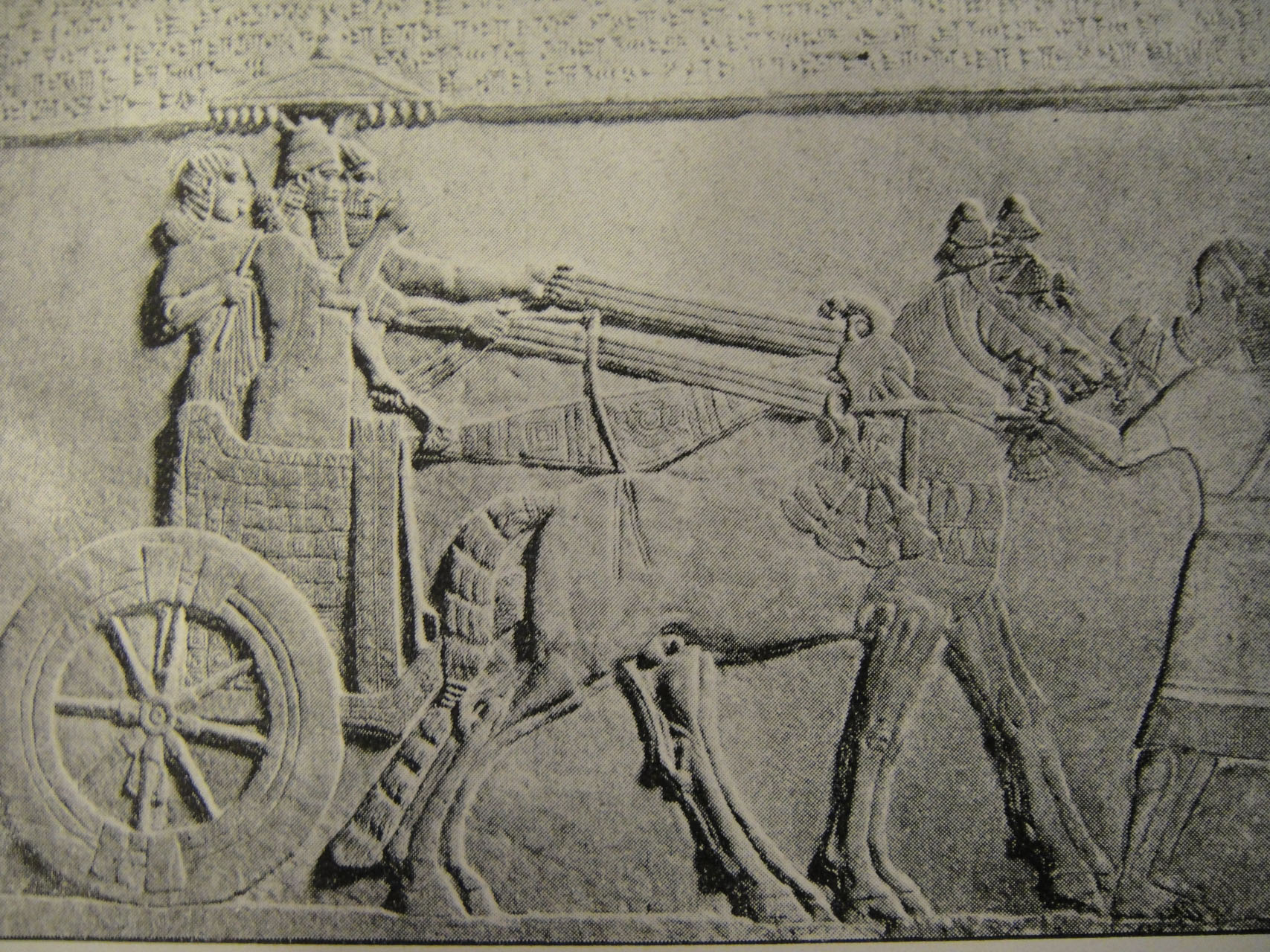
To enlighten this topic, we think useful to quote what a book recently written by Italian experts (Lorenzo Morello, Giancarlo Genta, Francesco Cavallino, Luigi Filtri, “The Motor Car. Past, Present and Future”, Springer Science, 2014) reports in its introduction to Part I:
For hundreds of thousands of years human beings lived without using any particular means of transportation. When they had to move an object, they simply lifted and carried it, if they were strong enough. If the object was too heavy, they arranged to drag it. It is likely that occasionally branches or other round objects were slipped under the load to reduce friction, but no evidence of this practice remains.
With the Neolithic revolution the need for transportation greatly increased at the same time that the practice of taming animals opened new perspectives. The development of agriculture created the need of transporting seeds to the field and crops back to the homestead. The number of objects that were considered important and necessary for humans to carry with them increased as a result of the new seeds of village life.
Sleighs were used in Northern Europe before 5000 B.C. , and their use in other places at that time can be inferred. Sleighs and sledges can actually be used for transportation not only on snow and ice but also on grassland, deserts and sometimes even on rock.
It is impossible to state when a sledge was mounted for the first time on a pair of wheels or who instigated this technical revolution. Ancient wheels ware made primarily of wood, so that little direct archeological evidence would remain.
The potter’s wheel was introduces about 3500 B.C. to produce pots with axial symmetry. The use of the potter’s wheel can be inferred from the marks left on pots made with it. The supporting wheel for vehicles is thought to have originated at about the same time.
The most ancient evidence of a wheeled vehicle is a pictogram on a tablet from the Inanna temple in Erech, Mesopotamia. This document dates back to slightly later than 3500 B.C., and includes a small sketch of a cart with four wheels, together with the sketch of a sledge.

Where wheeled vehicles were first developed is not known, but it can be inferred that it was in Southern Mesopotamia. It is impossible to know from ancient pictures whether the axle turned along with the wheels or it was stationary. It is however likely that the wheel did not derive from the roller.
After animals were tamed could wheeled vehicles be propelled in a proper way. In Mesopotamia both transportation vehicles and war chariots were pulled by onagers. Oxen were doubtless used for transportation as well.
The spoked wheel, which appeared about 2000 B.C., accompanied the use of horses to drive war chariots. It is not known where horses were first tamed and used for that purpose, but the scarce archeological evidence indicates that it likely happened in north-east Persia, and that from that region the use of horses spread throughout the ancient world, from China to Egypt and Europe.

Chariots became obsolete as military vehicles when the knowledge of riding became widespread. Only at the beginning of the first millennium B.C. the art of riding was developed enough and mounted warriors started to substitute chariots in the conflicts in the Middle East, North Africa and Europe. By the fourth century B.C. the armored cavalry introduced by Alexander the Great had a winning hand on most battlefields.
In Europe only the Celtic tribes continued to use war chariots, which were first carried north of the Alps by the Etruscans. Celtic wheelwrights learned the art of building wheeled vehicles and made significant progress.
When the military pressure was over, the progress of vehicles on wheels slowed down. Greeks and Romans used chariots only for ceremonies or races, while transportation on wheeled vehicles was hampered by lack of suitable roads.

The increase of commerce and the new needs of personal mobility which took place in the last centuries of the Middle Ages continued at a greater pace in the following period. A new confidence in progress and in the possibilities of technology led to try new experiments and to refine existing machines. It is believed that the steering of the front axle of four-wheeled wagons dates back to that period. The first coaches with the body suspended on belts or chains date from the beginning of the fifteenth century, but the innovation did not spread out fast. In 1665 steel springs were introduced for the suspension of vehicles, but only at the beginning of nineteenth century this practice became general and it was possible to suspend the heavier vehicles on steel springs.

At any rate, in spite of all the progress in the means of transportation, journeys on land were still made on foot or on horseback. Still in 1550, in Paris, only five coaches were reported, including that used by the Queen.
The widespread use of prime movers like the water wheel and the windmill lead some visionary to forecast the construction of self-propelled wheeled vehicles, even if there was no practical means to implement this idea. Drawing of wind wagon were common in the “theaters of machines”, that are books containing the sketches of a number of actual and fantastic machines. The use of sails could yield better results; other attempts were made using clockwork mechanisms.
In these applications the wheel had not only the usual task of supporting the vehicle but also that of producing the traction needed for motion.
In order to build a truly successful automotive vehicle it was necessary to wait until a viable thermal engine, with a power/mass ratio high enough to operate a vehicle able to transport an engine plus a certain payload, was available. This idea was around since at least the seventeenth century: for instance in 1681 the missionary Verbiest reported that a steam vehicle had been built in China and a sketch in a work of Isaac Newton shows a vehicle propelled by the reaction of a steam jet.
In spite of these early ideas, it was only at the end of the eighteenth century that a suitable thermal engine was available, but a further century had to pass before the early attempts could produce vehicles that could find practical applications.
