
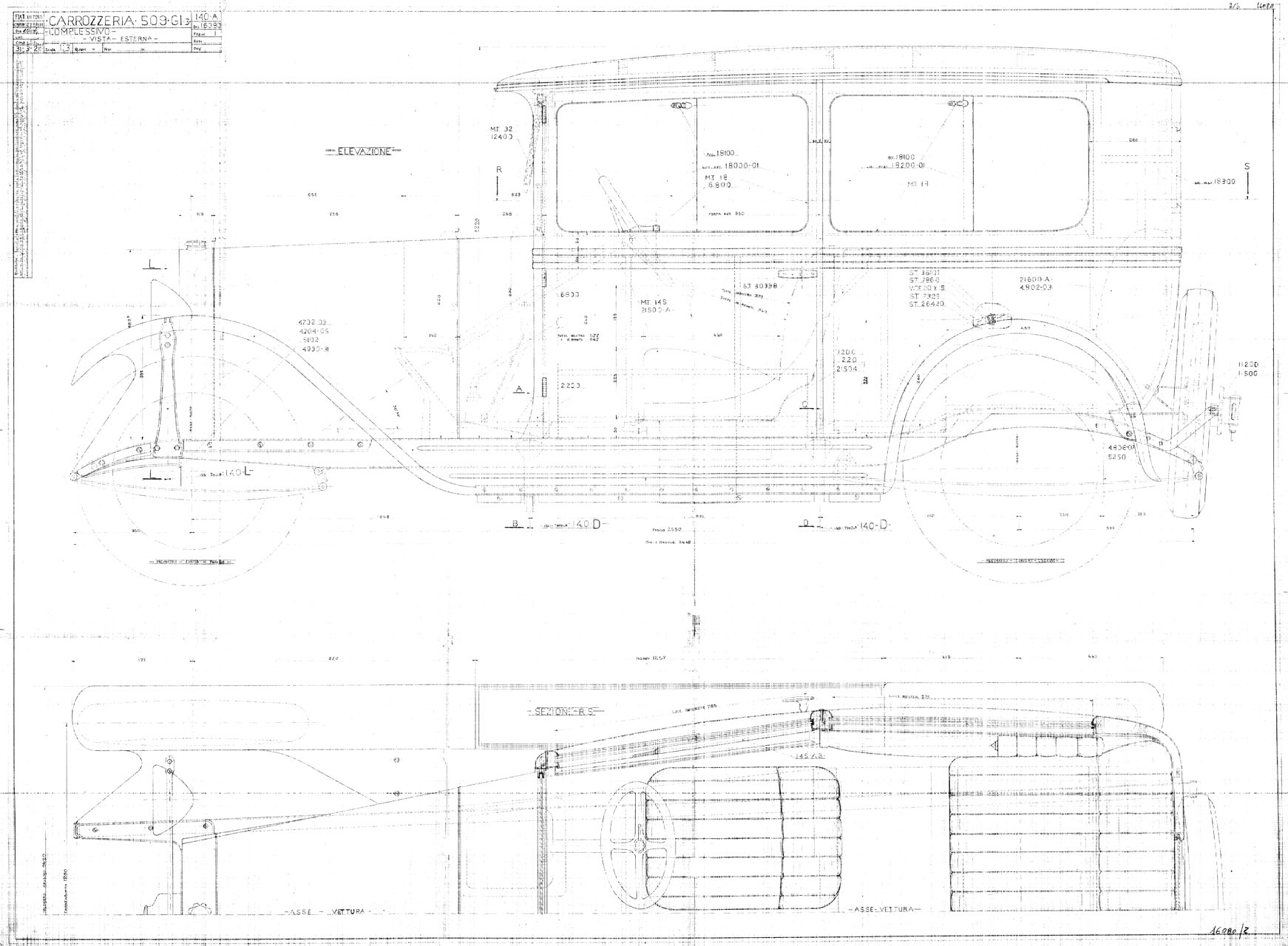
Fiat’s utility passenger car, mounting a four-cylinder engine with overhead timing and less than one-litre capacity, reaped success from 1925 to 1929. The 509 A model appeared in 1926 and was an improved version of the original model. The saloon on display has a Weymann body (invented by the Frenchman Charles Torres Weymann) with a wooden shell covered with imitation leather that provided a certain amount of “give”and noise reduction. The 509 was the first Fiat car that could be bought on hire purchase through the SAVA company.
Presented by Emilio Rugiadini, Torino
Engine: 4 cylinders
Capacity: 990 cc
Max. power output: 22 bhp at 3400 rpm
Max. speed: 78 km/h
Weight: 1165 kg
Fiat 509A
Fiat presented the 509 at the Paris Motor Show in October 1924 and it was immediately defined as “the big success for the small Italian bourgeoisie”. Fiat exhibited its chassis, described its technical specifications (four cylinder 55 x 95 engine with a 900 cc displacement and brakes on all four wheels), but it did not reveal its price to increase the expectations. However, there was no doubt that this was “an actual vehicle with all organs in miniature” and that this could finally be the so much awaited Italian “runabout”. In the next months, however… all was silence: nothing more was heard about the 509, which also in its name seemed to be a younger sister of the 519. The specialized press wrote in January 1925, only four months after the Paris Motor Show: “It’s not like Italy has been lacking in generous resolutions and brilliant initiatives also in this field: we all remember – to crown a long series of noble tests – the FIAM voiturette… But what is missing is the subsidy of a large organization, the funding of a powerful capitalist group, the set of means that makes a very low-cost serial production possible. We remember the joy, a unanimous consent that seemed to be the expression of a dream come true, when we announced from Paris that the Italian 5 HP had finally materialized, right under our eyes: the Fiat 509. Great hopes were immediately generated; many found it seductive with its promise of a new life, the mirage of owning a car. But today all hope is gone: what is left is very far-away deliveries, too far away. The word is that Fiat does not yet have the necessary organization to build the type 509. This model will in fact be preceded by the “2-liter” 515 which, with the incomparable 501 and the luxurious 519, will constitute the outstanding “threesome” of the great Turin-based brand for 1925”.
Probably this silence was strategic, because the dark forecasts of this journalist were proved wrong with the grandiose presentation of the 509 at the Milan Trade Fair in April, in an external pavilion outside the Salone dell’Automobile and the Fair, expressly set up just for this car. The commercial hype that was immediately sparked was remarkable, a sign of a turning point in the history of automobile advertising communication because for the first time it was carried out with forms and methods of a deliberate American style. Once the Salone in Milan was over, the very same vehicles that had been exhibited were organized in a caravan travelling across all of Italy, from Milan to Genoa, from Florence to Siena, from Perugia to Rome, from Naples to Campobasso, from Ancona to Ravenna to Padua. A simple, but yet unseen, way of allowing the whole population, still far from imagining the invention of television, to see these vehicles from up close. All the branches and Fiat dealers were notified to welcome the procession in the best possible way, to create a joyful expectation, a lively welcome. People from show business and culture were called into action, such as the playwright Sam Benelli who greeted the vehicles “as a flock of well-wishing doves set free along the roads of Italy”. The crowds would flock along the roads, as they did for the Mille Miglia, which was going to experience its first edition only two years later. The second step was the inauguration of a new sales system based on instalments, by means of a company created specifically for the occasion – SAVA – “for the sale on commission of motorized vehicles and cars in general paid by instalments”. This was something totally new in the Italian scenario, an important turning point in national social history. For the first time a specific body was created for the sale on instalments of automobiles which, as opposed to other similar organizations, did not pursue a commercial aim. SAVA in fact sold Fiat cars at list price, adding only the costs of the bank credit. It used Fiat’s own sales organs and ensured the seriousness, promptness, and efficiency of the mother company. With a down payment of 5,000 lire on delivery and 24 monthly instalments, for a total price of about 19,000 lire against the purchasing price of 18,500, SAVA transformed the 509 sedan from dream to reality for millions of salesmen, travelers, professionals, and women. Yes, women: because the third step of this yet unseen and greatly successful advertising campaign was exactly that of addressing the female public above all, and setting up a communication that insisted on this other half of the sky and still focused on the practicality, affordability, handiness, elegance of the vehicle, which are still today the core points of “female” advertising campaigns.
The last work of art to this effect was the touch that Gabriele D’Annunzio added to all this, an illustrious poet of the Italian literary scene and often in search of elegant expedients not to pay his bills. In December 1925 the poet noticed how much he yearned for a new automobile, which in the Italian language of the time was a word still used both in the male and female form, since it had not yet been officially attributed one single gender. No sooner said than done: he decided to ask Senator Agnelli for one. The latter sensed the advantages of that gift, and did not hesitate to send a 509 cabriolet to Gardone, a “jewel of Italian mechanics”, in an amaranth color, just as the poet had desired. D’Annunzio, eager to express his gratitude to his donor, carefully included a phrase in his thank you letter that not even a media expert of our day could have studied better: “Your car seems to solve the issue of the gender already debated. The Automobile is female. It possesses the grace, slenderness, and liveliness of a seductress; furthermore, it has a virtue unknown to women: perfect obedience”. Agnelli, pleased by the poet’s words, answered by immediate return of post: “Allow me to express my appreciation to you and to use your judgment also with respect to the public, which I could never in any case defraud of your sovereign decision that finally consecrates and uplifts the automobile to the reign of femininity”. And thus, while D’Annunzio consecrated himself as the only Italian citizen able to pay for a car with an apostrophe, Agnelli had yet another advertising tool in his hands to promote his car, female in all respects, destined for a public of young and industrious female drivers.
Women who, however, also had to be rather wealthy, because despite all the efforts, the 509 was still far from being a true people’s car. The sedan version cost 18,500 lire, paid an annual circulation fee of 366 lire, and that kind of money was not too compatible with the salaries of the time. An amount of that kind meant five years of a specialized worker’s salary, or two years for a small craftsman, a young professional, or an archivist in a ministry. Fiat made great efforts in the following years to lower the sales prices down to the bone: in 1928, the spider was sold at 14,500 lire, the torpedo at 15,900, the two-seater coupé at 17,500, the sedan at 17,800, the Weymann sedan at 19,500. But those were still high amounts. The production costs, on the other hand, did not make it possible to lower the retail price enough to really further its diffusion: the coachwork was prevalently built manually, with generous use of internal and external upholstery. The mechanics were anything but simplified; the chassis was composed by bolted and nailed elements that also required manual mounting. It is one of the last vehicles to impose an assembly with a wide use of specialized labor: some years later these systems would be overcome, and new methods using presses and molding would become predominant.
Although it had to juggle between old and new, the vehicle was born with a good dose of revolutionary spirit. Responsible for the project was Att. Carlo Cavalli, technical manager who in 1919 had been promoted to manager of car and industrial vehicle design in Fiat by Guido Fornaca, general manager of Fiat and, since 1920, CEO of the company. During the design process, Cavalli collaborated with Emilio Martinotti, from the technical design office, and Bartolomeo Nebbia, who had joined Fiat in 1911 and since 1920 had been appointed to Head of the Technical Engine Office. Also engineer Giulio Cesare Cappa joined the project, although for a short time, being employed in Fiat since 1914 as Head of the Technical Office and having contributed to the creation of the 519. He participated only briefly because he left Fiat in 1924. Despite its small size (it was the first Fiat produced in series with an engine below 1000 cc), the 509 was a high-range automotive product: entirely metallic bodywork, robust chassis, engine with camshaft and overhead valves, silent chain command, a truly innovative solution, a wide range of accessories and control tools, and a full range complete with all versions (torpedo, sedan, spider, coupé-cabriolet). The most interesting aspect is maybe the engine. In fact, as far as the chassis is concerned, the new Fiat runabout is not too innovative compared to other models that the company was already producing. In all of them, from the 501 onwards, that is the 505, 510, 503, 507, 512 etc., there is a clear imprint of Cavalli’s philosophy (since he was a lawyer and not an engineer): solid chassis, engines with cylinder block in cast iron on aluminum base, very long length of the rod compared to the stroke, side intakes. The 509 is different due to the overhead valves: a detail that makes it equal only to the 519 and the Superfiat, apart from the racing types with 401, 403, 405, etc. engines. The 509, with its 109 engine, is therefore the first example of a vehicle conceived for mass production, which simultaneously adopts camshaft and V-overhead valves. The advantages of this solution, which did not even imply excessive difficulties in its construction, are evident: hemispheric combustion chamber, high engine speed, no force of inertia, reduction of moving organs due to the lacking rods. The 109 engine is innovative also due to the intake manifold in the monobloc, due to which the carburetor is fixed directly to the latter’s wall. Also the monodisc clutch is different from the multi-disc type mounted on the other models in production. These avant-garde details reveal the attention Fiat was paying at the time to the world of races, and its effort to study racing vehicles and experiment new solutions, such as the supercharged engine (which Fiat was the first car manufacturer in the world to systematically adopt in its racing models since 1923). This explains the innovative effort and interest towards certain technical choices applied to a serial vehicle aimed at a vast public. What sounds a bit more unusual is the choice of the three gears plus reverse gear. No other Fiat vehicle adopts this Spartan solution, neither before nor after the 509, excepting the first Balilla from 1932, which was famous exactly for its “three gears”.
Was it successful? On the one hand, certainly yes: it was the first Fiat model of which more than 90,000 cars were produced. The initial versions were soon followed by the giardiniera and the commercial torpedo, forerunner of our day’s station-wagon, the landau for taxi services, and the spider siluro corsa. Updated in some mechanical details and turned into the 509A in 1926, it also reached astonishing racing results, such as the participation in the Montecarlo Rally in 1928 starting from Bucarest, where, driven by French driver Bignan, it asserted itself by covering the 3030 km distance in 85 hours and 46 minutes.
On the other hand, maybe no. It was taken out of production at the beginning of the 1929 crisis and replaced with a less brilliant and more conformist vehicle, the 514, after only four years of being on the market. This was because, with time, it became more and more clear that the 509 could not really become a true “runabout” for the masses. It however keeps the merit of having launched a new sales system combined with an unseen, sparkling, and colorful advertising communication which easily superseded the composed and stiff methods of the previous communication strategy. It also takes the merit of having given a sophisticated and elegant shape to the setup of the true people’s car, which is still valid today: one liter displacement, four seats, compact body. It wanted to be for everyone, but failed: that was its only flaw.
