
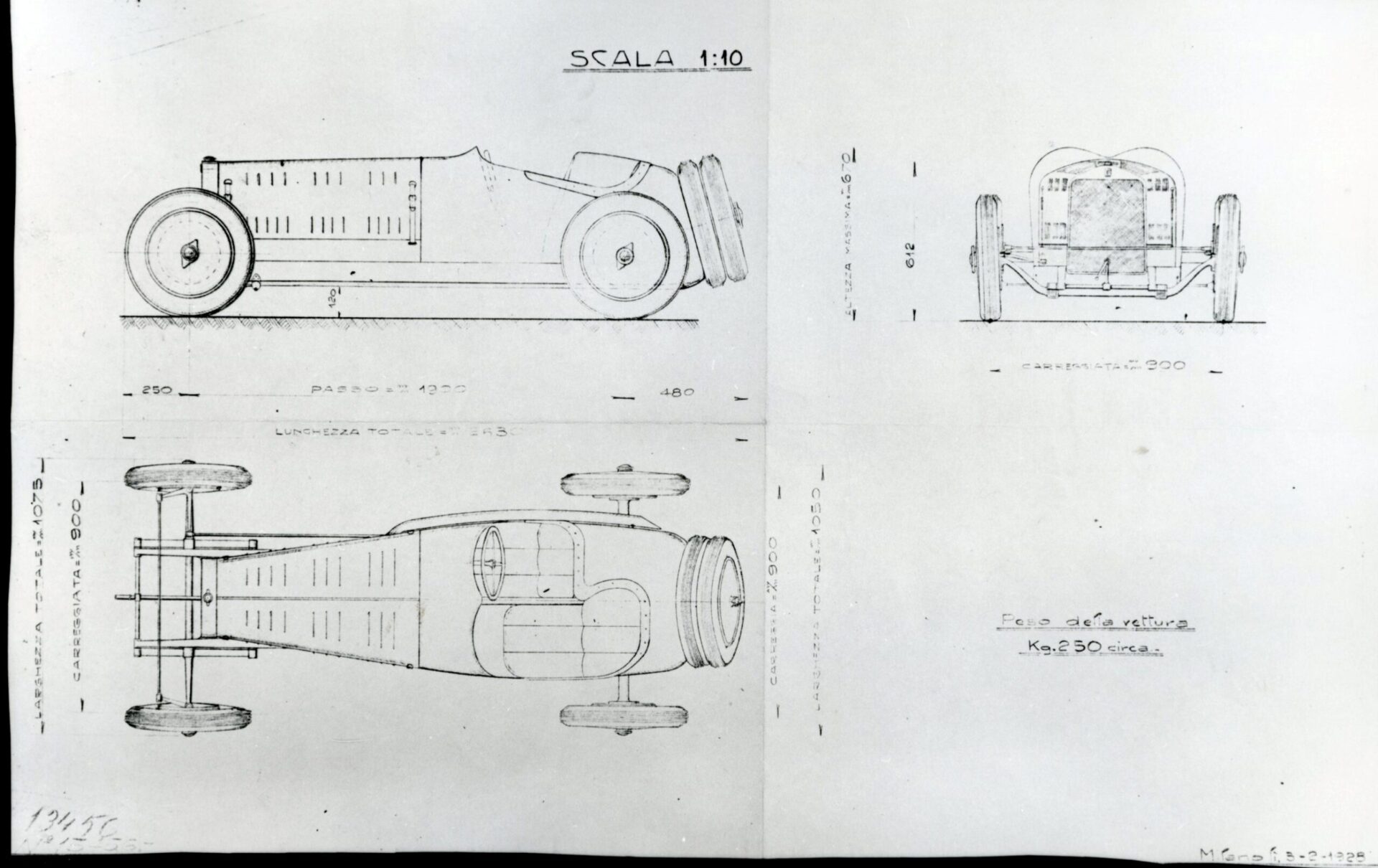
Isotta Fraschini produced just two ABC type vehicles for the young between 1928 and 1929. It was designed by Guido Cattaneo who had only recently joined the company’s technical office alongside his father Giustino, one of the greatest and most versatile Italian engine and car designers of the time. The vehicle was propelled by an authentic four-cylinder Peugeot engine producing about 700 cc, the same engine used on the Quadrilette economy car but applied to a lowered chassis and endowed with a real radiator. It therefore fitted a gearbox and, more generally, an orthodox mechanical layout befitting a miniature car. The plan was to produce a few dozen units per annum but this never happened. The differences with the other toy car it was inspired by, the Bugattina, immediately strike the eye: this was designed not so much for a “youthful” target but for children, it was an electric car and fitted a mock radiator.

So this is an Isotta Fraschini to all intents and purposes. It presents numerous interesting technical details, including the IF-patented front brakes and ribbed disc wheels cast in light alloy by IF’s own foundry that specialised in very light alloys; the steering control using two longitudinal shafts without coupling bar: a layout applied later by some of the early Maserati’s. The adoption of the Peugeot engine should not come as a surprise as in those days Isotta Fraschini represented Peugeot in Italy.
Thereafter, in 1934, the well-known Biella racing driver Carlo Felice Trossi bought one (the second went to the children of the Isotta Managing Director, Gian Riccardo Cella), partially modified the single-seat bodywork and installed a Cozette volumetric compressor which turned the car into a little racing car. The resulting vehicle was given to the Agnelli children and, in 1960, Gianni donated it to the Museum.
Engine: 4 cylinders
Capacity: 855 cc
Power output: 23 hp at 2500 rpm.
Speed: 110 kph
Weight: 230 kg
