
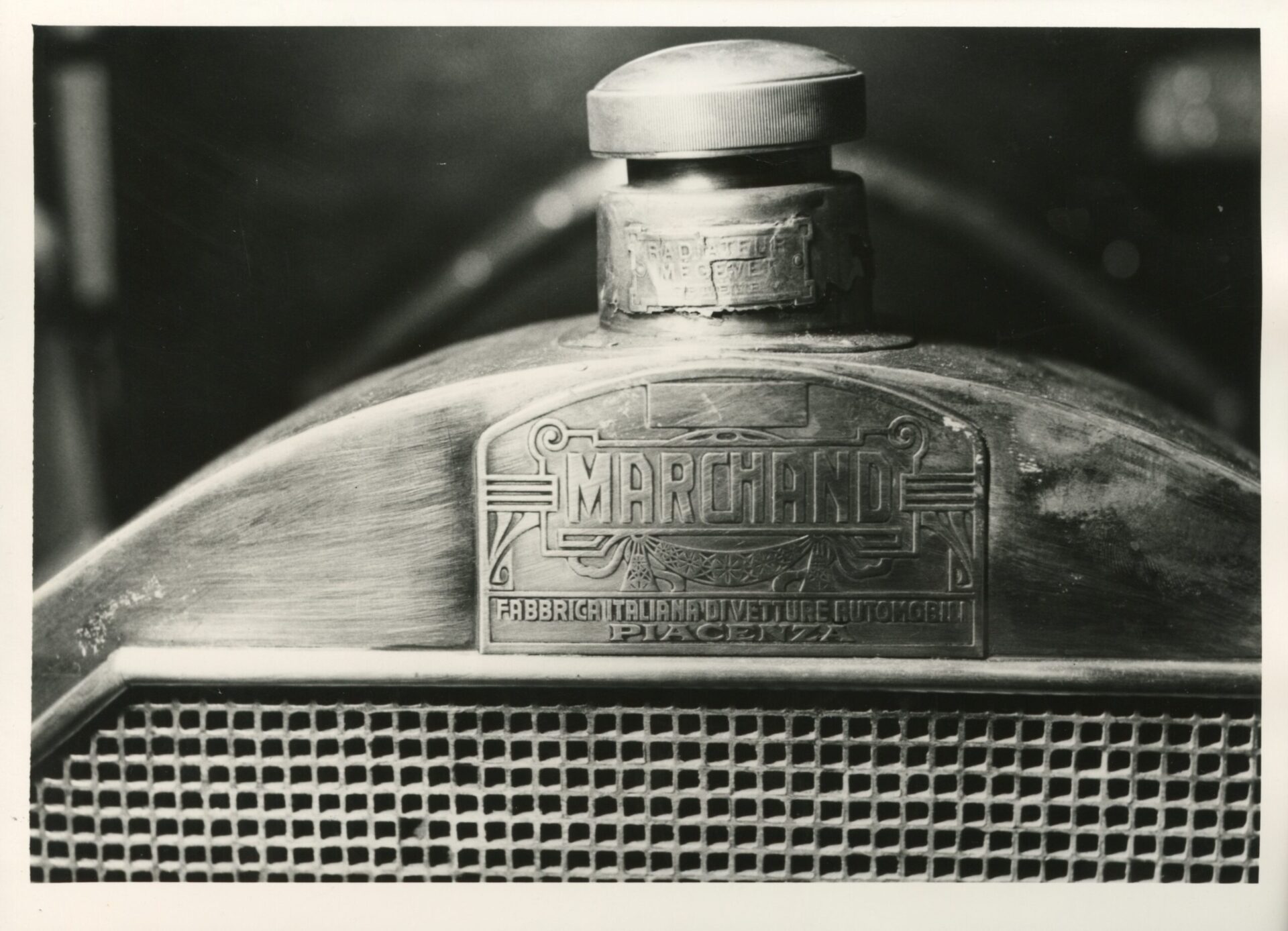
Orio & Marchand, one of the first Italian business to evolve from artisan to industrial scale, was established in 1898 when the Marchand brothers bought into the existing company of the Piacenza-born Stefano Orio, who produced bicycles and sewing machines with his sons Bartolomeo and Attilio. Paolo and Leone Marchand had embarked on a number of ventures in the mechanical and petroleum industries in Milan, Montechino and Velleja. Their first mechanical factory was founded in Musocco (Milan) in 1897, but after just a year, it was decided to move to Piacenza, in the Emilia region.

Paul Marchand
A closely knit community of cyclists was taking shape in the city, with a group of young men sharing the same passion for the sport. As well as the Marchand brothers and Bartolomeo Orio, this group also included Giuseppe Merosi, Ezio Bovolo, Bruno and Giuseppe Tamagni, who would later ride Marchand racing motorcycles, and Emilio Laporte, the brother in law of the Tamagnis.
It did not take long for the company to evolve from bicycles to producing motorbikes and cars. Powered by original engines, Marchand motorcycles performed respectively in racing during the early years of the century, ridden by Tamagni and Merosi. The brand’s first car (1899), however, had less auspicious beginnings, but its engine – a 770cc air cooled V-twin – was nonetheless worthy of note.
The second Orio & Marchand motor car was launched shortly after, in autumn 1900, with a front-mounted two-cylinder water-cooled engine driving the rear wheels via a secondary chain drive. This was followed by a succession of models with increasingly powerful engines. The best known of these were the 10 HP of 1902, of which only a hundred or so were built, and the more powerful 12/16 HP.
Merosi’s decision to pull out from the company was a severe blow for Marchand. At the end of January 1907, the merger with the Dufaux Frères company in Geneva was announced. But this was actually more a takeover than a merger, culminating with the two Marchand brothers also leaving the company. The Orio family, on the other hand, went back to producing sewing machines and agricultural implements independently.
The whole undertaking was a failure, however, with the company suffering particularly from the lack of a designer imparting a distinct personality on its products. Marchand-Dufaux was liquidated between 1907 and 1909, and nothing more was heard of the company after 1910.
