
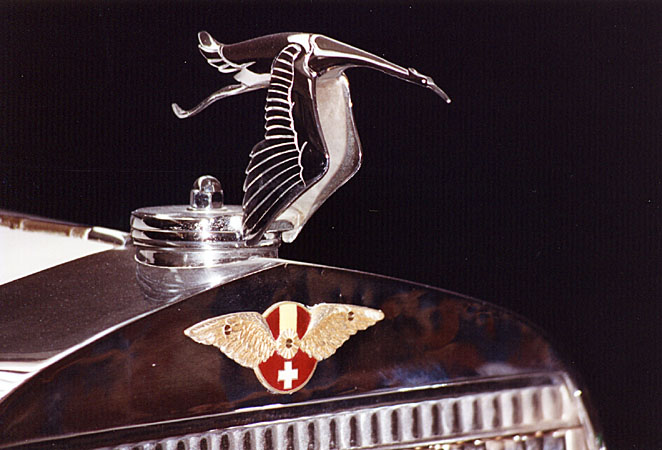
A Spanish rival to the English Rolls Royce and Italian Isotta Fraschini marques, Hispano-Suiza built motor cars that embodied sophisticated build quality and techniques, power, elegance and opulence.
The company was founded in Barcelona in 1904. That year, the Catalan trader Damian Mateu had purchased, together with his business partners Fonctuberta and Seix, the small De La Cuadra automobile factory originally established by J. Castro. The personnel of the factory included its technical director, the young Swiss engineer Marc Birkigt, who had previously worked for a watchmaker in his home country. The name of the company was changed to Hispano–Suiza, marking the start of the Iberian brand’s slow but continuous ascent to glory.

Its first model was the 20CV, a luxury car based on the old De La Cuadra models. This was followed by another two very upmarket models, powered by 4 and 6 cylinder engines respectively.
In 1909, Hispano-Suiza took part in the first edition of the Copa de Catalunya race founded by King Alfonso XIII. Its cars did not fare well in the race, however, and the 1910 edition was also a disappointment. But the year after that, with a new engine developed by Birgkit, the Hispano-Suiza cars finally managed to win. The car which won this race was used as the base for a new road-going model christened Alfonso XIII in honour of the King and organiser of the race itself.

With a 3600 cc 4 cylinder engine producing 60 bhp, this car was capable of over 100 km/h. But as well as being powerful and fast, it also boasted excellent comfort and handling.

In 1911, the marque inaugurated a new factory in Levallois, near Paris: and this firm new foothold in the French market would allow Hispano-Suiza to gain worldwide fame. In those days, France was the centre of the motoring world, and the Paris Motor Show was the most influential of all international events. By the following year, production at the French offshoot had already exceeded the output of the Spanish factory. As a result, Hispano-Suiza was now considered to all intents and purposes a Franco-Spanish marque.

The company changed over to producing aeronautical engines when the First World War broke out. Automobile production resumed normally once the hostilities ended, however, and in 1919, the company launched the H6, a model designed just before the beginning of the war and intended to continue the legacy of the Alfonso XIII. This model was to be the first in a succession of exclusive automobiles. Powered by a 6600 cc in-line 6 cylinder engine producing 135 bhp at 3000 rpm, the car featured a front dominated by two large Marchal headlamps and a vast honeycomb radiator topped by a stork with extended wings.

The stork emblem – the mascot of a French air force squadron – was only adopted in 1919: previously, the company’s insignia had consisted of two white wings over a small cross.

Around the mid 1920s, Hispano-Suiza sealed a major deal with Škoda for the supply of “Type H6B” chasses, which the newly founded Škoda Auto would then body and commercialise under the Skoda Hispano-Suiza brand. While they offered an even quieter driving experience – probably because of the superior metalworking expertise of Skoda’s engineers – the Czechoslovakian versions were let down by inadequate finish quality, and were not successful.
1931 saw the birth of the V12, Birkigt’s most complex creation to date. With this 9420 cc engine producing 220 bhp at 3000 rpm, the improbably long, gargantuan new Hispano-Suiza was capable of reaching 180 km/h. But as well as more power, the new V12 was even quieter than previous engines and completely vibration-free. In 1934, the capacity of the V12 grew to 11,310 cc, making it bigger than any other engine in production at the time in Europe or America. A power output of 250 bhp pushed top speed up to 200 km/h. The V12 was built up until 1938.

The French factory attempted to re-establish itself on the market after the hiatus of the Second World War, but without success. The Barcelona factory resumed production at a limited pace and continued up until 1944, but was acquired in 1946 by the truck builder Enasa.
With over 35 engine designs to his name, Marc Birkigt passed away in 1953.
