
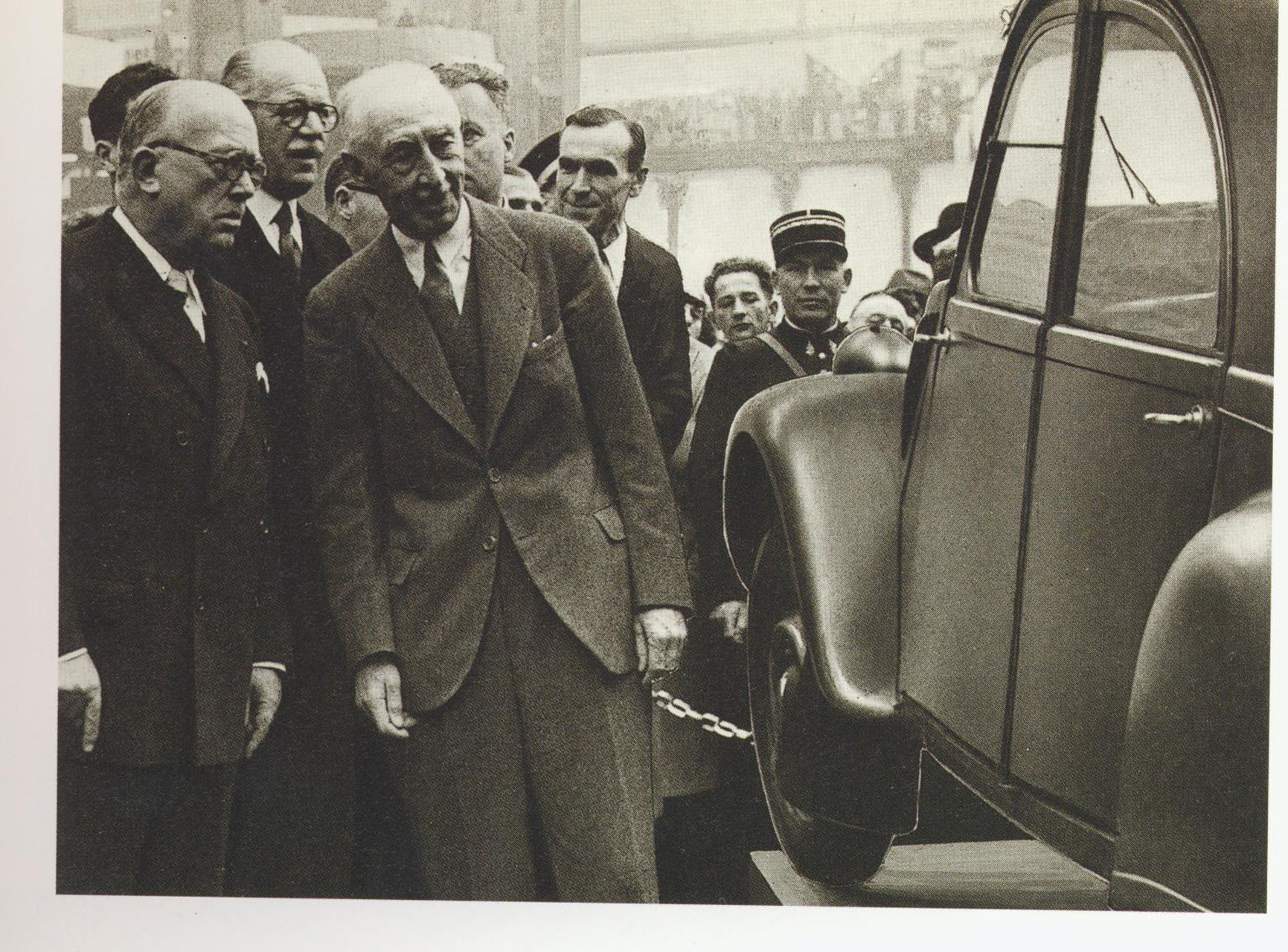
The French car company Citroën launched the T.P.V. (Très petite voiture) project already in May 1936. The instructions given to the designers (Italian Bertoni for the coachwork and French Lefèbvre for the mechanics) were simple, but demanding. The new vehicle was supposed to transport four passengers and a bag of potatoes at 60 km/h consuming 3 liters for each 100 km. The suspensions had to make it possible to cross a ploughed field with a basket of eggs, without breaking any of them. In short, the aim was that of launching an affordable, sturdy, practical car on the market, appropriate for farmers, small merchants, and craftsmen. Two working prototypes were ready in early 1939, but the breakout of the Second World War froze any further development of the model. It was not until the Paris Motor Show in 1948 that the world was finally able to see the first 2 HP. Its sales success was immediate: only a few months after the presentation, the waiting list was already three years long, and in 1950 the production went from the initial 4 models a day to 400. Many factors explain this success: its price was only half that of the Beetle, its consumptions very low, it was easy to handle, versatile, and could adapt to any kind of road condition. In France, the production of the 2 HP, which started in 1948, lasted until 1987 and went on for another three years in the Citroën plant in Portugal. More or less four million of these vehicles were built; and if you consider the commercial versions and the models directly derived from it like the Dyane, the Ami, the Méhari, the overall production counted about 10 million vehicles.
ENGINE front 2 cylinder
DISPLACEMENT 425 cc
POWER 12 HP at 3,500 rpm
SPEED 65 km/h
WEIGHT 556 kg
