
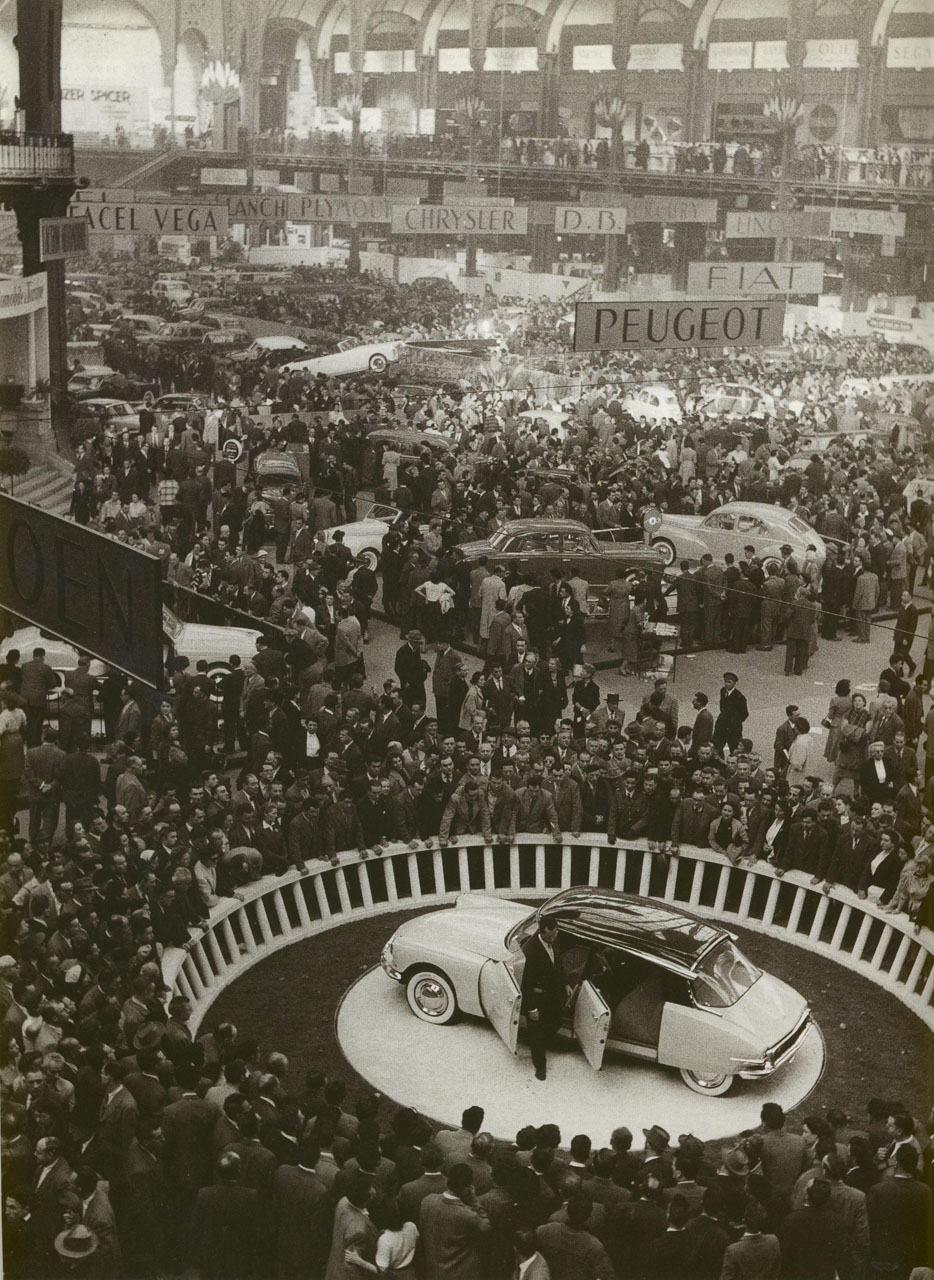
Presented at the 1955 Paris Show as a successor to the famous “Traction Avant”, and designed by the same Flaminio Bertoni, the Citroën DS 19 is one of the most representative cars of the post-war years. Certain highly significant innovative construction features, such as the hydro-pneumatic suspensions, the steering, brakes (front disc brakes) and gear change hydraulically assisted by a single control centre, were supplemented by this two volume body with an accurately aerodynamic line, a very rigid monocoque metal structure and reduced weight. Almost one and a half million of them were produced up to 1975.
Presented by S.A.André Citroën, Parigi
Engine: 4 cylinders
Capacity : 1911 cc
Power output: 75 bhp at 4500 revs/min.
Top speed: 140 km/h
Citroën DS
Specialized magazines and journalists said of this car: “At the Grand Palais, the new Citroën is a sensation” (“La Croix”); “The car that opens a window on the future” (“L’Automobile”); “The main attraction of the Motor Show” (“L’Equipe”); “It looks like the car of aliens” (“France-Dimanche”); “A car that can deeply influence global technique” (Gordon Wilkins); “The impression of having skipped one generation in the history of cars” (Paul Frère); “Its appearance really constitutes a new fact in the evolution of cars” (Robert Braunschweig); “A manufacturer in 1956 proposing a vehicle from 1966” (Jacques Ickx); “It is a car that one cannot imagine but in its original shape” (Battista Pininfarina). Furthermore, the already quoted Roland Barthes, French philosopher, writer, and semiologist born in 1915 and deceased in 1980, stated in his work “Mythologies” (1957), talking exactly about the Citroën DS: «Je crois que l’automobile est aujourd’hui l’équivalent assez exact des grandes cathédrales gothiques : je veux dire une grande création d’époque, conçue passionnément par des artistes inconnus, consommée dans son image, sinon dans son usage, par un peuple entier qui s’approprie en elle un objet parfaitement magique. », a rightly famous and very quoted passage (“I believe that today the car is the precise equivalent of the great Gothic cathedrals : I mean a great creation of the time conceived passionately by unknown artists, and consumed in its image, if not its use, by an entire population which by means of it appropriates itself of a perfectly magical object”). Barthes consciously used words like “magical” and “creation”, which until that time had been rarely used to describe a mechanical object in everyday use. But the Déesse was something else. It had nothing to do with the cars built until that moment, in Europe or in the world, both due to its technical characteristics, and due to its futuristic lines, signed by the father of the Traction Avant and the 2HP, that is, Italian Flaminio Bertoni. It was closer to a science-fiction vehicle, or an experimental prototype, or even a one-off model than to a normal mass production car. Formal and aerodynamic needs led the sculptor Bertoni to work out a low and wide shape, reminiscent of a shark, with thin pillars, a wide glass surface, panoramic windshield and rear window with curves that joined at the side windows, in perfect harmony with the horizontal belt line. While designing the body, he chose to work with clay, instead of at the drawing table (his usual method), and modelled an aerodynamic bodywork around a chassis whose rear-wheel track was about 20 cm narrower than the front wheels. The side, with the faired rear wheels, was rather clean and without trims; the aerodynamic profile was characterized by the long and pointy front, practically without grille, so as to reduce the rolling resistance as much as possible and to contrast with the short and less pronounced tail. Its shape could certainly be reminiscent of flying saucers, with the inclined sides to offer less grip for side wind. And the surprises continued also once you sat down inside the cockpit. No drive shaft tunnel would stick out in the passenger compartment, so on the wide seats there was room enough for five people. And magically the curved rear window would remain dry even under pouring rain. The steering wheel only had a single spoke, the gear stick placed over the steering wheel also had the function of starting the engine. Even the pedals were different from the usual ones. The clutch was absent, since it was an automatic gear car; the brakes were a button placed at the center of the floor with the accelerator to the right. There was no hand brake because the parking brake was pedal-operated and placed at the very left of the driver’s seat. Going from the exterior shape to the technical specifications, the surprises keep coming. Independent wheels with hydropneumatic suspensions, hydraulic systems for the various automatic and power-assisted commands (power steering, power brakes, automatic clutch), front disc brakes, front wheel drive with engine group, clutch and gear block on the front. Its variable height hydropneumatic suspensions and new radial tires provoked its characteristic kind of rolling, which anyone getting in or out of the car could perceive. When you got in, the car would lower itself to then slowly go back to its normal height from the ground, and the contrary would happen when you got out. The height of the vehicle from the ground could be regulated by the driver by means of a knob, from 16.5 cm up to 30 cm. The hydropneumatic system used a non-compressible liquid (mineral oil) and a compressible gas (nitrogen), to maintain a soft handiness and an excellent road grip. Also, there were at least two people whose lives were saved by this system: no less than Charles de Gaulle and his wife. In August 1962, a Renault Estafette van driven by terrorists involved in the bloody Algerian events of those years pulled up alongside the presidential DS. The terrorists opened fire from up close hitting both the wheels and the coachwork. The President’s driver, Francis Marroux, lowered the gear from the fourth to the third, and was thus able to accelerate and get away. The extraordinary handiness and distribution capacity of this vehicle, even with two flat wheels, made his task easier, and the De Gaulle couple survived the incident, unharmed.
In its twenty years of production (1955-1975) no substantial changes were made to its appearance: the original and successful shark shape was kept unchanged, and maybe the most evident modification, exactly in the middle of its production history (1965), concerned the headlights which were made to move together with the steering wheel to eliminate blind angles. On April 24th, 1975, the last vehicle of the one and a half million DS produced left the factory.
