
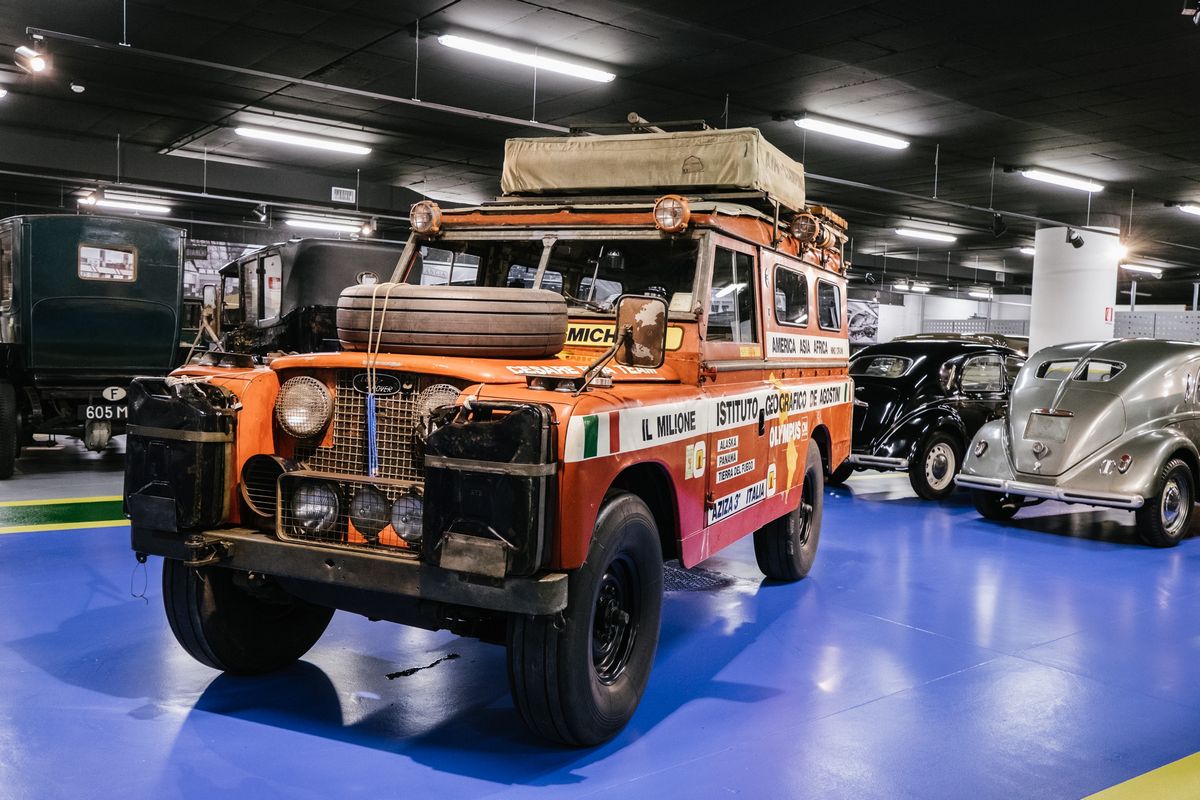
Meaning ‘beloved’ in Arabic, Aziza was the name chosen by architect and photographer Nino Cirani (1926-1998) for the 6 vehicles he used for his expeditions around the world, with the first christened in 1962. Aziza 3 is a petrol-powered Series 2 Land Rover 109. From July 1968 to May 1969, this car was the protagonist in a journey across both American continents from north to south: an incredible voyage through 18 countries (US, Canada, Mexico, Guatemala, Salvador, Honduras, Nicaragua, Costa Rica, Panama, Colombia, Venezuela, Ecuador, Peru, Bolivia, Argentina, Chile, Paraguay and Brazil – and with 64 boarder control check points, another record in its own right), in a 102,000 Km route from Alaska to Tierra del Fuego taking 326 days (and over 25,000 litres of petrol). During this voyage – the longest rally raid ever completed at the time – Aziza 3 also set the record for the highest altitude attained by a motorised land vehicle, reaching the 5007 m peak of the Cerro Rico in the Bolivian Andes. The car also reached 80 metres below sea level, in Death Valley. The overall average daily distance covered was 314 km, with an effective average (when actually driving) of 554 km per day.
During the voyage, Cirani also attempted to cross the impenetrable Serrania del Darien jungle in the isthmus of Panama, but was forced to turn back after a few tens of kilometres. This was in fact an impossible undertaking with just one vehicle and without adequate support, and it was only a number of years later (between 1971 and 1972), with an expedition organised by Land Rover for the launch of the Range Rover, that the crossing was finally made.
During the journey, Cirani took thousands of photographs and kept a minutely detailed diary, which the magazine Quattroruote (which sponsored the initiative) summarised in a series of articles between June 1969 and February 1970.
It took Cirani 1500 hours of work to prepare the vehicle. The external accessories included a roof tent (Air Camping), several fuel jerry cans (for a range of 1100 Km on normal roads and 6-700 Km on difficult terrain), two spare wheels and supplementary spotlights. Inside, as well as clothing, spare parts and tools, the car also carried all the photographic equipment (including a small fridge for films), a cooking stove and a special drinking water system with two tanks and taps inside the cabin. Land Rover was always the obvious choice for Nino Cirani’s expeditions, for the technical superiority, extraordinary space and truly incredible robustness of its models. He used both the short wheelbase 88 and the long wheelbase 109, which was roomier and offered more carrying capacity. With the first Aziza – a Land Rover 88 – Cirani completed his first long distance raid, a 31,000 Km journey from Milan to Ceylon taking 4½ months (138 days). In 1965, he drove from Cape Town to Cairo with Aziza 2: a 53,000 Km journey through 19 countries taking 8½ months (268 days). Then it was the turn of Aziza 3 – but it took two years of work to plan the journey and raise the funds necessary.
It was worth the effort though, and Aziza 3 was to be Cirani’s inseparable travel companion for the next twelve years: up until 1980, when the destination this time was the Sahara.
Over the next years Nino Cirani’s tireless quest as an all-wheel drive explorer continued, taking him all over the world with five expeditions to the Sahara (1972-1973-1974-1978-1979), new crossings of Asia (1975) and Africa (1977), and journeys around Australia (1978), New Zealand (1978) and Iceland (1980).
Engine: 4 cylinders, in-line
Capacity: 2286 cc
Power: 77 bhp at 4250 rpm
Manually selectable four wheel drive
Top speed 105 Km/h
Weight 1494 Kg (excluding modifications)
